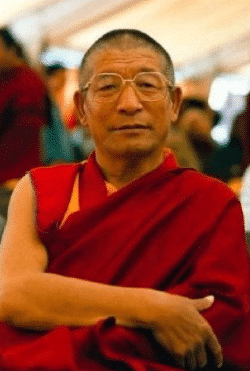
Rabten Rinpoche
„From my earliest childhood, I used to meet monks dressed in cherry robes who came from the great monastic universities near Lhasa. I admired them so much! At other times I would visit the great institute of our region and, when I attended the monks' debates, I felt an unbridled attraction; around the age of fifteen, I began to notice how simple, pure and purposeful their life was. At the same time, I realised how, compared to theirs, my existence was complicated by the eternal repetition of the same daily obligations.
Before one could one day be one of the qualified monks of the monastery of Dhargye monastery, situated nearby, it was necessary to study and train one's mind in the doctrine of the Buddha (Buddhadharma) for at least three or four years in one of the three major universities located near Lhasa. With the intention of becoming a qualified monk of the Dhargye community, I decided to go to one of these monastic universities. At that time I was about seventeen years old and I was not at all keen to become a great Dharma scholar.” Excerpt from the biography of Gheșe Rabten, „Life of a Tibetan monk”
At the age of eighteen, Geshe Rabten embarked on a three-month journey from his birthplace in Kham in Eastern Tibet to Lhasa in Central Tibet, where he became a monk at Sera Monastic University. Before long, both his teachers and other students realised his magnificent character traits. While studying and meditating, he experienced incredible hardships. That is why the teachers and other students gave him the name Milarepa. Because of the clarity and precision of his logical debates, he was compared to Dharmakirti, the great Buddhist logician. After studying for about twenty years, he passed the cheeses, before the monks of the three great monasteries. He was conferred the highest title, „Lharampa Cheetah”. This is the highest honour, which is bestowed by the examiners and His Holiness the Dalai Lama.
In 1964, Gheșe Rabten was chosen for the position of assistant in philosophy to His Holiness the Dalai Lama, with the task of both assisting His Holiness while receiving teachings from his two tutors and engaging in debates with His Holiness on philosophical topics.
In 1969, the Dalai Lama sent the first Western students to Geshe and later, due to the large number of Western students, he asked Geshe to move to the Tibetan monastery in Rikon (in Switzerland) to become its abbot, and to spread the Dharma. At that time, Geshe had many Tibetan students from the great monastic universities in India, but because his senior master Kyabje Trijang Rinpoce was getting older and because Geshe had no interest in the comforts and money of the West, he would have preferred to stay in India. He agreed to leave only when his master indicated to him that his teachings would be a great blessing to the people of the West.
Geshe was the first Tibetan Buddhist master to bring the complete Vinaya tradition and the study of the five great subjects of Buddhism to the West. Therefore, Geshe became in the West the „pioneer” of the complete and complex teachings of Buddhism. Many famous masters in the West today were disciples of Geshe, for example: Gonsar Rinpoche, Sherpa Rinpoche, Tomthog Rinpoche, Zopa Rinpoche, Lama Yeshe, Lama Yeshe, Geshe Penpa, Geshe Tenzin Gonpo, Geshe Thupten Ngawang, Geshe Thubten Trinley, and so on.
Almost like no other, Gheșe Rinpoce has succeeded in making the essence of Buddha's teaching accessible and in bringing listeners closer to it. Whether the listener was from the West or from Asia, whoever followed his words felt all the fuzziness disappear, and instead a clarity and calmness of mind took over. His examples encouraged people to adopt a sincere way of acting. Whatever he explained, he gave the disciple the feeling that he was hearing a description of the past or the future, or their innermost secrets, as if they were all in the palm of his hand.
Gheșe founded the Rabten Choeling Centre for Higher Tibetan Studies (originally Tharpa Choeling) near Lake Geneva, the Tibetan Centre in Hamburg, the Tashi Rabten Centre in Letzehof, the Puntsog Rabten Centre in Munich, and the Gephel Ling Centre in Milan.